skip to main |
skip to sidebar
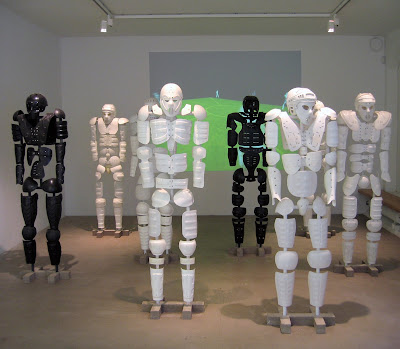

 Performance principle
2007
Eight figures in combination with projected 3D animation
Hard plastic protection elements from various sport equipment, vetonit base, wood construction
Competitive sport in general and international competitive sport in particular carries a message through its very structure. It manifests in rating nations, teams and individuals, and states at its basic core the Western cultural thinking of being -a competitive society. Not only have modern athletes compete against each other but they also have measure their achievements against records set by already deceased colleges. Their achievements are eternally fixed within our mainframe of time and space.
Western culture acts to firmly entrenched pattern and believes that manifests them self unconsciously and are rarely challenged. There seems to be an (cultural) overriding commitment towards the performance principle. Apply the rules, let the rules define the process; let the process go on without limits.
In this particular work I was dealing with the afterlife of athletes, individuals that lived their live striving for acceleration, broke borders with will power or drugs and are unlike to stop, even by death.
The installation Performance principle displays a combination of sculptures and computer animated video projection. The sculptural part consists of nine individual crafted players. Sexless, bulky and scary, their bodies are mere exoskeletons, abandoned shells by their previous owners.The amour plates that circumscribe their bodies are compiled of hard shell protection parts collected from sport equipment.


 Entelechia
-(from Greek en in, telos purpose and echein to have)
2007
Current scale is 700 x 300 cm
A selection of spherical-ball-shaped designs in down spiraling complexity,
collagen, and needles, Plexiglas bubbles, drawing of a digestive system
The used polygons shapes are the following (simple to complex)
Triangle (trigon), quadrilateral (tetragon), pentagon, hexagon, heptagon, octagon, nonagon (enneagon), decagon, hendecagon (undecagon), dodecagon, tridecagon (triskaidecagon), tetradecagon (tetrakaidecagon), pentadecagon (pentakaidecagon), hexadecagon (hexakaidecagon), heptadecagon (heptakaidecagon), octadecagon (octakaidecagon), enneadecagon (enneakaidecagon) icosagon, triacontagon, tetracontagon, pentacontagon, hexacontagon, heptacontagon, octacontagon, enneacontagon, hectogon
When considering origin of life we usually take the evolutionary viewpoint starting from the simple and its qualitative changes toward the complex. In the installation “Entelechia” it happens reversed inside a gigantic digesting organ that swallows the complex and ejects the simple. The Installation "Entelechia" depicts a picture of a gut system that is painted straight at the gallery wall.
The term “Entelechia”, originates in the writings of Aristotle about his understanding of life and
the force of life as laid down in one of his later treatises “De Anima”.
“What we call life is feeding, growing and atrophying in a self-containing process”, Feeding, in other words, is the basic feature of life. It takes part in a dual movement: Outwardly towards a possible source of food and inwardly back to the organ itself.”
Yet this takes place in a self-containing process and these processes are in it self the living thing”.
Now this classification of life can be applied to its simplest life forms like bugs, seeds, microorganisms and of cause us as humans on a basic level, as we are as Aristotle puts it-an organ within a self-sustaining system.
“When something appears in the full splendor of its very essence and shows what it is and what it is capable of being purely through itself (eidos), it enters a state of fulfillment and contentment in which it assumes a concrete form.” Maintaining this state is what Aristotle calls “entelechy”. Entelechy may further denote a force propelling one to self-fulfillment. There is an internal drive within the organ of atrophying and intensifying that reflects the performance principle.
Within the parkour trough the digestive system- the various shapes of geometric cutting forms go on a tireless journey. The very complex-meaning freshly swallowed, higher complex species are cradled in the stomage but will soon proceed towards simpler versions of the same specimens. These shapes furthermore continuo their journey through the labyrinths of the gut system that- finally being done- will displaying the simplest triangular pyramidal shape that will periodical ejected by the disposal port (anus).
The material you can see encased in the acrylic bubbles is called collagen, an animal based tissue layer underneath the skin. This material I was able to “purchase” during a summer job in a pharmaceutical industry several years ago and I am still experimenting with it.
Collagen has the consistence of handmade paper, but when moisturized becomes flexible like thin sliced bacon. Pinned with needles to a computer generated cutting mask it transforms- during a several day long drying process between calculated fixation points.
By behaving this way it breaks the stiff geometrics and stretches into gentle curves, though forming a living geometry.
My work process started with creating computer generated three-dimensional models of the used polygons. Think about them as wire frame objects (not solid but made like out of glass, and being translucent) -so that one could see its whole symmetry. The advantage is that I can radiate this models around itself into a position that is visual interesting and less symmetrical.
Now a soccer ball surface has clear visual symmetry from our point of vision, but it also extends itself to a not perceivable backside. By proceeding in the earlier mentioned way (making them transparent) I had them both (front and back) clear visible and was separating each on of them in two-dimensional layers.The two layers with its radius and junction points were further transferred to paper on witch the collagen was fixed with needled and left to dry. After the drying process these two layers were combined by witch the “backside” was lifted 1cm, and the front side 3 cm of from the paper.This creates the effect of the work as being a spatial object.
The installation “Entelechia” used to go under name “Eat this”; -that had been a work name-tag.
As artist I feel free to change names at points that a new idea finally settles and if you read about this piece on other pages, don’t get confused about it. Insights often occur, by the fact that my works are often more than an individual sculptures but generate within bigger installations. There are temporary several works that I consider to be ongoing project by means of being unfinished or ongoing collections. “Entelechia” is a work in process, meaning that it is adjustable and extendable.
Likewise the installation-collection by the name “Skinned polygons”, “Eat this!" is visualizing an evolutionary process revolving around a round shape. (I like the way it sounds.)
It is not my aim to claim deeper meaning to my works by connecting them to specific concepts of ancient Greek philosophers- but in a way I often find their sort of reasoning fitting to a certain school of thought that I enjoy from a sculptural point of view.
Please feel free to skip this train of thoughts and just go for the visual -or being interested in this topics-to read the first chapter of the second book of Aristotle’s -De Anima.


 Out of Pakistan
2004- ongoing
Current state, tent 280x150x150 cm - tarpaulin 280 x 300 cm
38 Illustrations, 4 frames, 50cm x 70 cm each
Pakistan is producing 80% of sport balls sold in the world. Almost 75% of these are made in the city of Sialkot that services for more than 200 producers People flock to this city from far away to find work and produce the items that are marketed as "lifestyle" products.
The balls that are all hand made are manufactured in close to 2000 workshops. In the cities sheds and backyards are rafley 40000 men and women stitching away, each subcontracting to a Pakistani company.
Most modern footballs are stitched from 32 panels of waterproofed leather or plastic- 12 regular pentagons and 20 regular hexagons. The panels are Hand stitched; with pre punched stitching holes (combined with a latex bladder)- in this way 32 Panels are held by 720 stitches that a soccer ball need to be accomplished. A skilled worker needs three hours and 750 stitches to piece together the 32 separate panels with waxed thread with a maximum of three balls a day to deliver to the downtown manufacturer. His or her reward will be the equivalent of 1,80€ a day. Their handiwork will sell as quality product under a brand name that costs close to a 100€ in European stores.To make ends meet many families have been including their children into the manufacturing process.
In 1996 however, during the European championship, activists lobbied to end the use of child labor. This eventually led to the Atlanta Agreement, which seeks to reform the industry to eliminate the use of child labor in the production of balls. The outcome however is still controversial because the former integrated minors are now send to work in more dangerous working environments and the production lines are focused on factory facilitations often difficult to reach by the locals that have to travel every day and are disconnected with their social bounds. Throughout the last two years it got a lot worse, if you go today in a sport shop you will find that the trend clearly goes to glued soccer balls that are made in several East Asian countries.
Chinese competition is threatening from below, bombarding the market with cheap, mechanically stitched balls. The Thai producers are bearing down from above, whittling away at Khawaja's market share with their high-tech, glued product. His competitors have already scored a major victory. This year's World Cup stadiums will not be sporting hand-stitched Adidas balls from Sialkot. Glued balls from Thailand will be taking pride of place.
It takes strength to drive the needle through the thick plastic. I made the experience myself working on this project. For over five years I have been collecting old soccer balls, dismantling them, cutting out the pentagons and sewing the remaining pieces to become a tarpaulin. There is only a certain amount of pieces one can sew before ones fingertips say- that’s it. The collected items have all been played and wear the marks of heavy usage.
This project has been my long lasting ambition to create a sculpture that can serve as a refuge shelter entirely made of soccer balls. 2009 it will finally reach a surface size that will make it recognizable as a tent like shelter, a survival tent entirely manufactured by soccer balls.
I also used the inflatable bladders (usually made of either latex) to make a comfortable air mattress that guaranties a soft and cozy sleeping surface.
During this project I have also teamed up with the German artist/ illustrator Martin Markes that created accompanying illustrations to this project.
Our junction point originated in a newspaper article based on a story wherein German custom officials discovered two Pakistani minors in a cargo container full of sporting equipment at the international cargo airport in Frankfurt. Like media sources claimed, the two boys that have been employed, as ball stichers in the city of Sialkot were eager to travel to a country were the best soccer is played.
My sculptural work goes along with the 38 illustrations of M.Markes that contain a visual diary of their adventures journey.Between the evergreen lawn of the stadiums and the dusty ball factories exists a space in whom dreams and reality mix.. Both works invite you on a fantastic journey to the land and the people of whom we know little and can only assume.
Please check out the article by Uwe Buse, Football and chains http://www.spiegel.de/international/spiegel/0,1518,418139,00.html

 Field studies
2004
98 Drawings and ground plans sport fields, board games and child play, ink drawing on paper
150x560cm, growing
Western relations to nature have been characterized by mastery rather than co-existents.
In the field of sport this mind set is especially dominant, manifesting in the fact that our playing fields are anti-nature and have to be- according to the fact that modern competitive sport has to facilitate a near laboratory setting in which its uni- dimensionality can unfold itself under controlled conditions. Pure nature has too much variation, too much noise, so it all has to become mapped, planned and graphical within the sense to keep locked out the immeasurable, unknown and unknowable.
Generally, playing fields are wide expanses of grass, dirt or sand without many obstructions.
A playground is used for playing sports or games; a playing field further refers to any place or context within which competitive activity takes place. It is also used as a metaphorical term in economics as the term “leveled field”, a plateau on which no external interference affects the ability of the players to compete according to a set of established and agreed rules.
In my works I often counter-target this conformity with individualism- a clash of special designed spaces for specific purpose- versus un-manipulated urban/ nature settings and the human urge to reclaim its right to imaginary play and to claim its private space.
Within this working process my idea was to create a collection in which the boarders of established systems in pro sports activities and child play blend into each other and lead the spectator to loose its grip in process of differentiation. Kids game chalk drawings found on streets and parking lots, board games as well as ground plans of sporting field’s stretch into a master plan of human activity. There is no hierarchy in the placing, every game every sport begins with a line that divides, allocates and grows with the complexity of the play.
The work Field studies consists play concepts that have been originated for more than 4000 years. The more than five meter long drawing displays 98 fields and disappears into a thorax like paper dispenser that offer more space for future finds.

 Armory
2006
Plastic hardshellprotectors from various sport uniforms, sandblasted glass walls, light tubes
The work was installed in the facilities of a former Jewish steam bath in the city of Wiesbaden. The spaces (bath, massage and showercabines) have been contributed and used for artistic installation work by the Fluxus Friends Wiesbaden e. V.
The selection of protective shells were arranged and fixed on backside illuminated glass walls.
An Armory is a depot used for the storage of protective equipment and offensive weapons.
I transformed the space by the motto, “Put your gun down brother”, the ritual of laying down your protective shells and engaging naked and unprotective the unique atmosphere of the spa.
Wiesbaden is one of the foundation places of the Fluxus Movement and the nice people that run the place keep up the founding spirit and spreading the founder’s movement with lots of enthusiasm and charisma.

 Ballroom
2007
Collection of balls (marbles to fist size ball specimens), steam bath with sandblasted Plexiglas membrane, light tubes, oversized glass test tubes with primal colored ball selection
In 2007 I had an exhibition in Wiesbaden in the Gallery of The Fluxus Freunde Wiesbaden e. V
in cooperation with the Finnish artists Sari Palosaari and Mia Rinne. The Exhibition was curated by artist group located in Frankfurt a M called 431 art and the show went under the name “Northbound-installations and media art from Finland”.
The exhibition spaces were located in a former Jewish bath and consisted of various shower and spa facilities that were provided to install spatial artworks. One of the cabins provided me with a stainless steel bath that I modified for the work “ Ballroom”.
Remembering the childhood pleasure of lying within a sea of balls I filled the bath with over thousand unique specimens of balls. These have been collected over the last five years and just were asking for to being presented in this particular way.
The work went together with the work “Pharma CV”, a color sorted selection of balls in oversized glass blown test tubes on the wall.
 Eternal Erection
Rotating phallic sculpture sewed out of reflecting soccer-ball elements
2004
90-x18 cm, telescope stand
Ancient sculptures of Phallus symbols have been found in many parts of the world, notably among the vestiges of ancient Greece and Rome. Within many ancient cultures, phallic structures were symbolized with male fertility and the penises as well as the testicles were portrayed unrealistically huge and prominent. An erection is usually, though not exclusively, associated with sexual arousal, in many ancient cultures phallic structures centrally focus on adult male audience performances.
Sports like Soccer come often along with stereotypes of masculinity and Macho attitudes. It is considered and celebrated as a bulwark of men that we vigorously defend and in which context we celebrate our masculine gender role. In most parts of the world football evokes great passions and plays an important role in the life of individual fans, local communities, and even nations; it is therefore often claimed to be the most popular sport in the world and the only one that has its own worldwide understood idiosyncratic language. Millions undergo the strongest emotionally involvement during the games and the hype forces enormous pressure on the management, teams and individual players on high competitive level. The after mach of the world championship is often called “the big meat market”. A sell out of players that are both popular and skillful.
There are seventeen laws in the official Laws of the Game that were formulated by the International Football Association Board. Ironically this seems to match with the term “The ring of seventeen”, witch is a slang word for the steroidal substances and derives from its unique build up, -a ring of 17 molecules which functions as a magic key that through this unique build up can penetrate cell walls and fool around with the actual DNA. Even the schematic chemical drawing with its molecular structure of one five and three six edged polygons seems to resemble the classic soccer ball design.
Check out the image (http://en.wikipedia.org/wiki/Steroid)
Testosterone is a steroid hormone from the androgen group. It is the principal
Male sex hormone and an anabolic steroid used for phallic enlargement and its performance improving abilities are considered to be a form of doping in most sports, particularly given the lengths to which athletes and professional laboratories go to in trying to conceal such abuse from sports regulators. The uses for anabolic steroids in sports and bodybuilding are controversial, because of their adverse effects and the potential to gain unfair advantage.
The work” Eternal Erection” is a 90cm high Phallus made by dismantling and assembling a bigger amount of silver reflective technique Soccer balls size 5.
The sewed Sculpture in its enlarged and firm state is fixed on a slow rotating motor placed on an “erectable” Tripod. A halogen beam creates a nice disco effect that illuminates the work and high lightens the form in all its splendor and glamour.


Mappa Mundi
2003- ongoing
Collection of unfolded balls from the field of sport, 12 Glass Frames, 140x160x8cm
Along active games the most highly developed global ones - are played with balls. When I slowly started to collect those items it became aware of the multiplicity of ways in witch they were formed and shaped.
It all started with a “Hacky Sack”, a fist-sized ball that was made out of triangular patches and had a label saying, “Made in Guatemala!” Cutting it open I found that it had a filling of black granulate that I later identified as being of volcanic origin. Something struck me than. I bought a ball made in the opposite side of the world, that was filled with a substance taking from the very heart of this country. It was a fascinating poetic thought and I was hooked.
I have to confess that it became an obsession and I have gathered more than a thousand individual items. Mappa Mundi is a collection of these balls that I collected on many years and journeys all over the world. The collection Mappa mundi was a starting point for a series of works that inhabit the idea of being ongoing collections. In the processes of collecting, ones own taste and vision, forms the individual core of a distinctively collection policy. While selecting I define unique objects belonging to a certain category and quality and therefore they are accepted into my private collection. Each one of the balls must have been played and has to have an individual construction pattern. Having fulfilled this terms the items are cut and unfolded along its sewing lines. Alienated in this way and presented in glass displays, they more likely seem to remind of ritual objects than belongings of the field of play and sports.
With their fillings of volcanic granulate, rice, seed, bones, reindeer fur, sound mechanisms, liquid and handwritings, each ball seems to reveal a new secret. It helped me mapping some unknown territory- so also the name of the work is related to this. Mappa mundi means Map of the World.
In my working method I sympathize with a 17th century tradition of creating ones own “Wunderkammer”, a cabinet of wonder, or a wonder-room. In their historical definition these collections often contained a mix of fact and fiction, cabinets were filled with preserved animals, horns, tusks, skeletons, minerals, as well as other types of equally fascinating man-made objects: sculptures wondrously old, wondrously fine or wondrously small; clockwork automata; ethnographic specimens from exotic locations.
As a artist/ collector I am got a lot of inspiration from the publishing’s and writings by “The Royal Society of London for the Improvement of Natural Knowledge”, that was founded in 1660 and is known simply as the Royal Society. I understand this movement as a group of renaissance people that were collectors preserving the old and searching the new, traveling to foreign countries engaging with other cultures and were constantly generating knowledge through hands on experiments.
Mappa mundi- a ongoing collection in the sense of this world is a very inspiring but also difficult work to handle. Consisting of ten segments it is rather big and not suitable to be shown in many galleries spaces. Furthermore I would not consider about selling it in pieces because the single frames compliment each other and are a growing collection, unique in this sense.
It consists out of ten segments with three further in preparation. Nevertheless there has been an offspring of works originating from the main collection. The last one was a big size format 150x 300 cm that was put on display at the 3rd Beijing Art Biennale in Beijing 2008.
 Enemy mine
2006- ongoing collection-not yet exhibited
Eye pleasing objects assembled and reassembled by material collected from sporting and play activities that resemble anti personal mine-like objects,
Colourfull and eye pleasing rotating 3 D animations from anti personal landmines to be exhibited on various small LCD screens
Land mines are controversial because they remain dangerous after the conflict in which they were deployed, killing and injuring civilians and rendering land impassable and unusable for decades. As of 2007, a total of 158 nations have agreed to a banning treaty.
Thirty-seven countries have not agreed to the ban, including China, Finland, India, Israel, Morocco, Pakistan, South Korea, Sri Lanka, and the United States. Finland remains the only country in the European Union (EU) that did not want sign, ratify or accede to the Mine Ban Treaty.
The President of the International Committee of the Red Cross (ICRC) responded to the news of this delay with an editorial in a Finnish weekly magazine, appealing to the government to accept the conscience of humanity because, “When States anywhere in the world remain outside of this norm, they provide a justification for the continued use of anti-personnel mines everywhere.”The international community clears approximately 100,000 land mines each year. During the same period between 2 and 5 million new land mines are laid. Land-mine proliferation thus adds each year two or more decades to the1100 years that would already be necessary of having all these land mines to be cleared at the current state.
Land mines are in reality a weapon of mass destruction, in slow motion, because they indiscriminately kill or maim massive numbers of human beings over a long period of time. Some of the largest numbers lie in wait in Africa and Asia. Virtually all combatants use land mines. The countries most devastated by land-mines are probably Afghanistan, Angola and Cambodia and Afghanistan that have an estimated 10-15 million mines in place, -dangerously are also the about 1 million mines along the Iraq-Kuwait border and around the Iraqi city of Basra. Which the US and its allies have laid.
Land mines cause enormous pain and suffering. It is clear that many of these have been randomly scattered in inhabited areas precisely to cause civilian casualties and terrorize the population. Adults caught in the blast of an anti-personnel mine often survive with treatment, though they usually lose a limb. Children are less likely to survive because their bodies are so vulnerable. There are basically two types of land mines: anti-tank and anti-personnel. The most dangerous to children are the anti-personnel mines that explode even under the gentle pressure of a child's hand or foot. These come in a bewildering array of shapes and colors that can seem an interesting discovery for a curious child. One of the most infamous is the 'butterfly' mine, designed to float to the ground from helicopters without exploding, but with a shape and color that also make it a deadly toy.
 Greenaway dish
2003
Bouquet of color selected balls in glass bowls
The works name refers to the British film director Peter Greenaway.
The objects are displayed in an almost clinical style namely as specimen’s that grow in Petri dishes, nevertheless the balls colonies seem to overflow in their fruity and fresh appearance. The arrangement made me think of the beautiful food and flower displays as being seen in Peter Greenaway’s movie, The Cook The Thief His Wife & Her Lover.
The visual hallmark of Greenaway's cinema is the heavy influence of Renaissance painting, and Flemish painting in particular, notably in scenic composition and illumination and the concomitant contrasts of costume and nudity, nature and architecture, furniture and people, sexual pleasure and painful death.
 Pharma CV
2006
Glass blown oversized test tubes, selection of ball specimens sorted by colors
I often feel a natural distrust towards competitive sport, and particularly against competitive sport at the international level. This is not an argumentation against individual, or collective achievement, player and teams trying their best to win, but the problem is if the method of achievement is competition at whatever cost. Western thinking and conception of life is highly dramatic. Everything hangs on the competition. Heaven or hell, win or fail.
Passion is the thing that the artist shares with the athlete, it keeps us going and at the same time to enjoy our profession. Art and sport on their best are and should be primary motivated.
In my works this issues come often in disguise of happy colored and playful objects from the world of play and sports but they also point to a dark underlying current.
Curriculum stems from the Latin word for racecourse, referring to the course of deeds and experiences through which children grow and mature in becoming adults. Pharmacology
(From Greek, pharmakon,”drug”, and–logia.) is the study of drug action. The Pharma CV comes here in the color of a rainbow but the glass test tubes hint also to a hidden and more sinister aspect. One could not phrase a better example as a quotation from the article (The Convicts of the Road) by the French journalist Albert Londres.
Following the Tour de France in 1924 he recalled the following interview with the previous year's winner, Henri Pélissier, his brother Francis and a third rider, Maurice Ville -that all had pulled out after a row with the organizers. Henri explained the problem - whether or not he had the right to take off a jersey - and went on to talk of drugs.
"You have no idea what the Tour de France is," Henri said. "It's a Calvary. Worse than that, because the road to the Cross has only 14 stations and ours has 15.
We suffer from the start to the end. You want to know how we keep going?
Here..." He pulled a phial from his bag. "That's cocaine, for our eyes. This is chloroform, for our gums."
"This," Ville said, emptying his shoulder bag "is liniment to put warmth back into our knees."
"And pills. Do you want to see pills? Have a look, here are the pills." Each pulled out three boxes.
"At night, in our rooms, we can't sleep. We twitch and dance and jig about as though we were doing St Vitus's dance..." Henri spoke of being as white as shrouds once the dirt of the day had been washed off their bodies, then of being drained by diarrhea, before continuing:
"There's less flesh on our bodies than on a skeleton, Francis said,
“The truth is, that we keep going on dynamite!"


 Trigger
Kinetic experiment
Bowling balls, metal cables
2004
Kinetic energy can be passed from one object to another. We experience this process during the game of billiards when the cue ball collides with another ball, passing its kinetic force on to it. Collisions in billiards are effectively elastic collisions, where kinetic energy is preserved.
Newton's cradle, named after Sir Isaac Newton, is a device that demonstrates conservation of momentum and energy. The most popular office toy was produced in the early 70th under the name “clackers”. Due to the high cost of steel ball bearings later on used, the Spanish company called Scientific Demonstrations Ltd used high-density plastic balls instead.
In my installation “Trigger” I used seven matching bowling balls suspended from metal wires fixed to the ceiling. The work has been shown on my travel exhibitions “Playontology”2004 in Köln and the “Ball of fame” show in Berlin 2006 and always managed to attract an eager crowd for experiment with it.
It was interesting to find that “The Geek Group in Kalamazoo, Michigan” created a similar work in 2006. It is on public display and is used for science and technology demonstrations. Even though I beat them in time, they managed an array of 20 bowling balls to work. Its worth to check them out under http://www.thegeekgroup.org
Newton’s cradle, the original table version has been the most popular of all office toys. Office toys have been getting popular since the 1990s. Many companies even encourage employees to bring toys to their office for reducing stress. Different types of office toys accompany different functions or purposes. For example, Playing "Puzzles" arouses creativity while playing "Toys that involve physical activity" can let the user's mind rest without falling asleep at work. Users of office toys are usually office workers or adults, but it is not unusual for children to play with, since many toys were designed for kids in the first place. Most office toys are placed on office desktop. The purpose of bringing toys or playthings to the office are providing amusement, boosting creativity and relieving stress.


 ArmorE
2004
Hard-shell protection parts originating from various sport uniforms, sandblasted light tables, neon light pipes, stainless steel punctured walls
Burial sites are extremely satisfying for archeologists, as they provide a
“Closed context” site (the objects all relate to one specific moment in time), full cultural, religious, and scientific evidence. The Archeologist Howard Carter must have been one happy fellow as he in November 1922 discovered the tomb of the Egypt pharaoh Tutankhamun. Along wooden shrines and an amazing array of statues, furniture and jewelry the grave contained board games and playing balls. We may assume that the Archaeologist, opening a grave that has been sealed more than 3000 yeas ago and finding a ball, must felt in that moment an emotional mental connection to this ancient fellow human being. . It also has to be mentioned at this point that first of all Mr. Carter came to Egypt to work as a artist and illustrator that was copying inscriptions and paintings.
King or pawn, the ball and the player have always been the heart of the drama.
Presented on light tables the installation Armor E could be a bizarre find of an archaeological digging site
The works consists out of hard-shell protection parts taken from various sport uniforms. Especially sports like ice hockey or American football with hard physical contact developed unique uniforms that transform the game into a fantastic visual event.
The pieces were puzzled together- rearranged to form a male and female body.
Are they the ancient King and Queen of Sport rituals?
 Collection
2004
Hard-shell protection parts originating from various sport uniforms, visual sorted
Collecting is considered to be very personal and in the process of selecting we also reveal a lot of our self. Rules or method are usually formulated during active search, some type of limitation is a natural part of an individual's selection process. Most artist are also collectors and it is not only about the possession of certain items but its always hints towards a work in progress. I have several such collecting projects; usually it takes me years before some actual work originates out of these. It is also acquired knowledge in this activity that I find valuable, one gets to know the whole lifecycle starting from the producers, facilitators, users and the final steps of disposing or recycling methods. I work a lot with items originating from the field of sports and have often hinted towards finding sponsors in the industry that could shortcut the collecting process but somehow I like the feel of an authentic find. I dig the authenticity of a well worn out soccer ball or a merciless battered protector plate having survived years of heavy impact by collision of players or other objects.
So this work consists of authentic wear gutted out of helmet, shoulder pads, elbow pads, mouth guard, protective gloves, heavily padded shorts, a 'jock' athletic protector, shin pads, chest protector, neck guards, face masks and specialized equipment designed to protect the player in action.


